





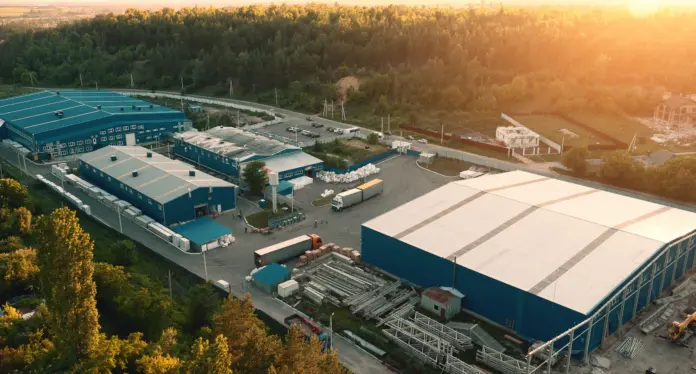
Wrocław is playing an increasingly important role in the European battery technology sector, and LG Energy Solution’s latest plans confirm that the company’s operations in Poland are entering a new phase. The EU’s largest lithium-ion battery factory is currently operating in Biskupice Podgórne near Wrocław, and the company is preparing to launch a new line dedicated to solutions known as energy storage. At the same time, new production technologies are being developed, expanding the plant’s portfolio and increasing its importance in the European supply chain. This is also important information for investors, as it shows that LG is consistently strengthening its presence in Poland and expanding its local expertise in the field of modern energy systems.
New production line – ESS energy storage systems near Wrocław
At the LG Energy Solution Wrocław factory, advanced work is underway to launch the plant’s first production line for ESS (Energy Storage System) energy storage systems. This is an extension of the existing business, which has mainly focused on the production of batteries for electric cars.
The first project implemented as part of the new line is an order for PGE in Żarnowiec. The system is to achieve:
• power up to 263 MW,
• capacity of at least 980 MWh,
• contract value: PLN 1.555 billion gross.
Importantly from the investors’ perspective, the project is based on the principle of local content — the batteries will be manufactured in Poland, and Polish companies are involved in the implementation of the infrastructure. In practice, this means strengthening the competence of the local market and developing the domestic supply chain.
Wrocław remains a key location in LG’s global strategy
The LG Energy Solution plant in Biskupice Podgórne has played a strategic role in the group’s production structure for years. It is the largest lithium-ion battery factory in the European Union, capable of producing up to 1 million batteries per year. Products from the factory near Wrocław are supplied to global automotive brands such as Volkswagen, Audi, BMW and Porsche, confirming the plant’s high technological standards.
The expansion of the factory’s operations to include energy storage systems is a natural step in the development of the plant, which has been one of the pillars of LG’s European operations for years. The introduction of ESS system production makes Wrocław an even more diverse location for the company, covering not only the electromobility sector, but also modern energy. This strengthens the plant’s importance in LG’s global supply chain and confirms that Poland is playing an increasingly important role in the company’s energy transition projects.
New production technologies in Wrocław – cylindrical and LFP cells
LG Energy Solution has announced further expansion of its plant’s operations next year. The new production line will be dedicated to cylindrical cells – a format that is gaining importance in the automotive industry.
Director Yong Girl Lee admitted that once all plans have been implemented, the Wrocław plant may become the only factory in the world that produces cells based on all advanced technologies available today in the battery sector in one location.
In addition, LG Energy Solution Wrocław is launching a production line for LFP (lithium iron phosphate) cells, which are key in the construction of energy storage facilities due to their:
• high cycle life,
• safety of use,
• resistance to overheating,
• and lack of cobalt.
LG is competing for further contracts for PGE energy storage facilities
Following the success of its bid for Żarnowiec, LG Energy Solution Wrocław is participating in another major PGE tender — this time for an energy storage facility in Gryfino (400 MW, 800 MWh).
However, the competition is greater than for the first contract. The cheapest bid is PLN 1.14 billion gross, while LG’s bid was PLN 1.36 billion gross. PGE is still analysing the bids, which means that investors are watching the development of this segment with interest.
Battery recycling — a key element of operations and future investments
LG Energy Solution emphasises that the development of the EV market and energy storage systems requires investment in advanced recycling technologies.
Currently, there is a shortage of high-efficiency facilities for recovering materials from batteries in Europe, which means that LG continues to send used components for recycling in Asia (South Korea, Singapore, China).
To reduce its dependence on foreign processes, LG, in cooperation with France’s Derichebourg, plans to:
• build a modern battery recycling plant,
• start investment in 2026,
• and launch the plant in 2027 in the Val-d’Oise region.
The new centre will deal with, among other things, the unloading, dismantling and shredding of batteries and the preparation of raw materials for re-production. Although the plant is being built in France, the Wrocław factory will be an important part of the European material cycle.
Environmental standards — key to investment assessment
In recent months, there have been reports of NMP emissions at the LG factory in Wrocław, but the company has issued corrections and explanations, emphasising that:
• the installations operate in a fully closed loop,
• unorganised NMP emissions are 0,
• organised emissions remain at 0.3–0.4 mg/m³, well below the EU limit (2 mg/m³),
• the Carbon4 report was initially based on outdated data from 2019.
In the investment context, this confirms the plant’s operational stability and compliance with EU environmental standards, which is essential in the battery industry.
Why might LG’s expansion in Wrocław attract investors’ attention?
The expansion of LG Energy Solution’s operations in Wrocław is not just another stage in the development of a large production plant — it is a move that is part of broader changes in the European energy and battery technology market. For investors, this sends several important signals:
- Strengthening the local technology base in an area that is growing faster than traditional energy
The development of the plant, which includes both EV batteries and energy storage, indicates that Wrocław is becoming a hub for expertise in two of the fastest-growing market segments. This paves the way for new production, service and research cooperation at the regional level. - Real-world use of energy storage systems in domestic projects
Work on ESS systems has a direct impact on domestic investments — the first solutions from the new line will be used in the PGE project in Żarnowiec. This means that technologies developed in Poland are being implemented in strategic energy projects, which increases the predictability of demand and reduces investment risk. - A sign of the company’s stability and adaptability in a changing regulatory environment
Diversification of production — in addition to car batteries, energy storage systems are also appearing — allows LG to mitigate the impact of changes in the global market, such as fluctuations in tariffs or shifts in demand. For investors, this means that the Polish branch operates in a model that is more resistant to external shocks. - Expansion of the value chain in Poland
The production of components for large energy installations requires the participation of many local entities — from infrastructure to technical services. From an investor’s perspective, this is a sign that an increasingly broad ecosystem is emerging in Poland around modern technologies, rather than just a single production plant. - Anticipated growth in demand for highly skilled specialists
LG’s expansion means growing needs in the fields of engineering, automation, health and safety, and project management. This is a factor that usually strengthens the local labour market, but at the same time increases the attractiveness of the region for companies looking for qualified teams and a stable investment environment.
The expansion of LG Energy Solution’s operations in Wrocław — both in terms of energy storage production and new production lines — shows that Poland is becoming a place where it is worthwhile for the company to develop projects related to modern energy technologies. The inclusion of the Wrocław plant in the European raw materials and battery recycling cycle further strengthens its role in the company’s long-term plans.
Lower Silesia is seeing the growth of a sector that may become increasingly important in the energy industry currently being built, based on energy storage and the use of renewable sources. The expansion of the plant not only increases the technological potential of the region, but also broadens the scope for cooperation between companies and institutions involved in the new energy industry.